NASA Data Clinches First-of-Its-Kind Stellar Merger
Astronomers observed the first real-time merger of a Sun-like star with a massive supergiant in the Andromeda galaxy, revealing new details about stellar evolution and common envelope events.
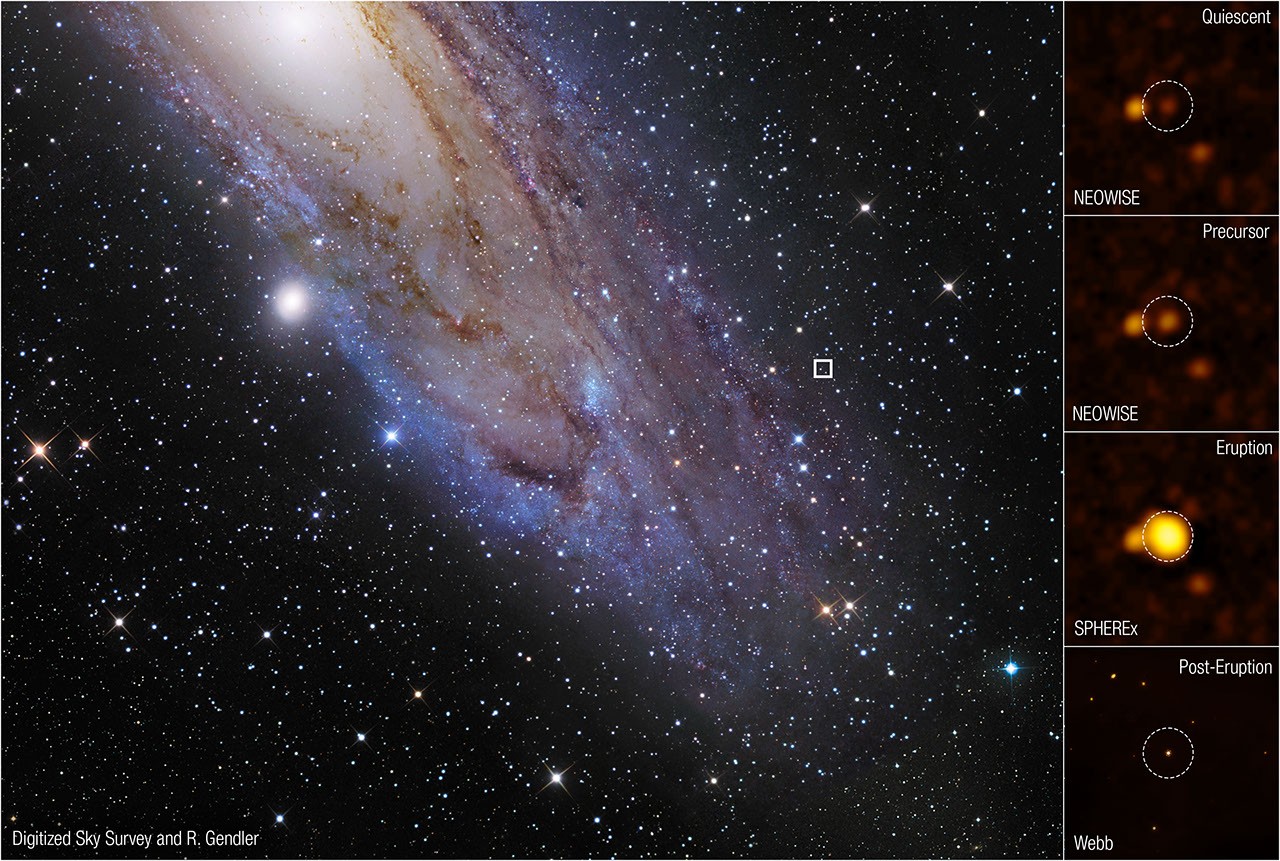
Researchers identified a unique stellar merger where a star slightly less massive than the Sun spiraled into and merged with a supergiant star in the Andromeda galaxy, creating a newly single star nicknamed Bao. The discovery was supported by rapid observations from NASA’s James Webb Space Telescope, cross-referenced with data from multiple ground and space telescopes. The event was initially detected in 2023 and erupted in 2025, with Webb capturing data just 47 days after the peak brightness, the earliest follow-up of such an event.
The merger occurred after only seven orbits—about seven years—after the smaller star made contact with the supergiant’s surface, a process that typically takes thousands of orbits in other binary systems. The team noted a rapid brightening within a week, defying expectations that such an outburst would take years. Observations revealed the smaller star stripped the supergiant’s outer layers, creating a shared gas envelope as the companion spiraled inward, losing orbital energy to drag.
The primary star, now dubbed “Big Bao,” was seven times the Sun’s mass, 350 times its radius, and 18,000 times brighter before the merger. The smaller star, “Little Bao,” was about 0.7 solar masses and was ultimately dragged into the primary’s core, ending the merger. The team reconstructed the event using simulations and mid-infrared data from Webb, which detailed centuries of dust shed by the primary star.
The findings provide a rare real-time view of common envelope evolution, a high-stakes phase in binary star evolution that can lead to neutron stars, black holes, or supernovae. The discovery highlights the efficiency of common envelope processes and offers a template for analyzing similar events. Future surveys by NASA’s Roman Space Telescope may uncover more such mergers, expanding our understanding of stellar dynamics.