What Is the Nancy Grace Roman Space Telescope? (Grades 5-8)
NASA’s Nancy Grace Roman Space Telescope, launching Aug. 30, 2026, will study dark energy, exoplanets, and dark matter from a stable orbit 930,000 miles from Earth.
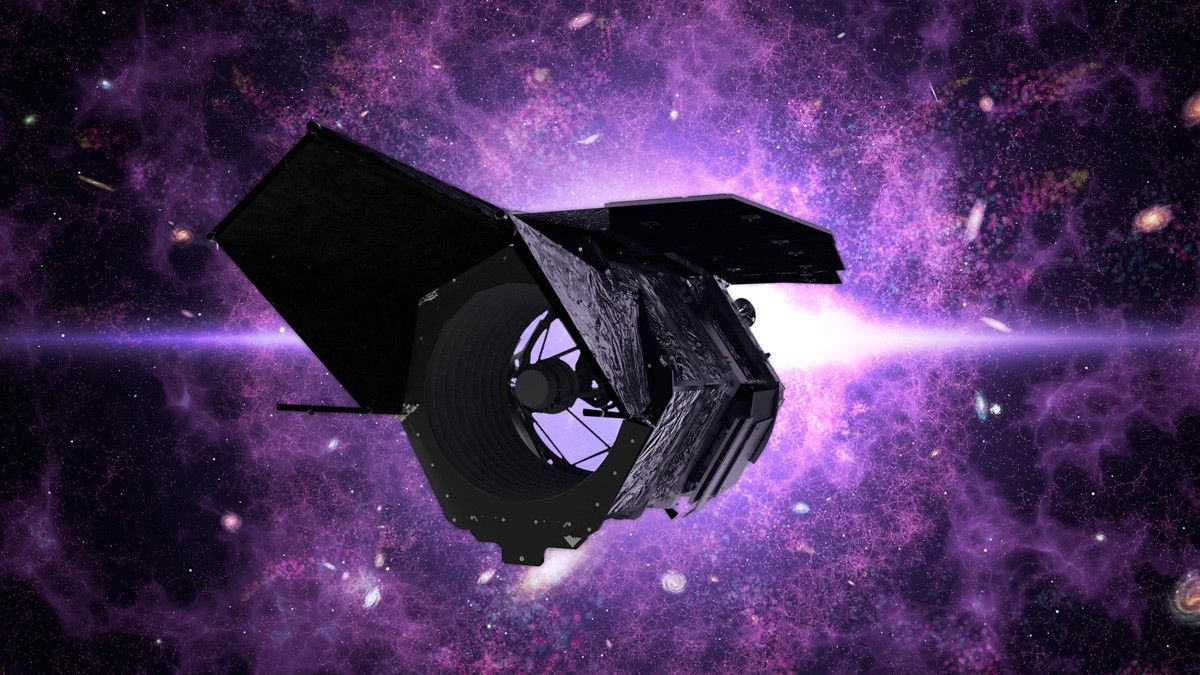
The Nancy Grace Roman Space Telescope is NASA’s next major astrophysics observatory, designed to survey large sections of the sky from a position 930,000 miles (1.5 million kilometers) from Earth at the second Sun-Earth Lagrange point. Scheduled for launch aboard a SpaceX Falcon Heavy rocket on Aug. 30, 2026, from NASA’s Kennedy Space Center in Florida, the telescope will operate with minimal fuel use due to the stable gravitational environment at L2. Its primary mirror, measuring 7.9 feet (2.4 meters) across, will collect infrared light to observe distant cosmic objects.
The telescope carries two main science instruments: the Wide Field Instrument, a 300-megapixel infrared camera capable of capturing light that has traveled billions of years, and the Coronagraph Instrument, which blocks starlight to reveal faint orbiting planets. The Wide Field Instrument will help scientists study the universe’s expansion history and the nature of dark energy, while the Coronagraph Instrument will enable direct imaging of exoplanets nearly a billion times fainter than their host stars.
Scientists will use Roman to investigate three key areas: dark energy, which accounts for about 68% of the universe and drives its accelerating expansion; exoplanets, where Roman is expected to discover new types of planets, including those in habitable zones; and dark matter, the invisible gravitational force shaping cosmic structures. Observations may help determine whether dark matter consists of heavy, slow-moving particles or lighter, faster-moving ones.
Named after Nancy Grace Roman, NASA’s first chief astronomer and a key figure in the development of the Hubble Space Telescope, the mission reflects her legacy in advancing space-based astronomy. The telescope was assembled by over a thousand technicians and engineers, including instrument technicians, mechanical engineers, and astrophysicists, each contributing specialized expertise to bring the observatory to life.