Roman Space Telescope Plaque Install
NASA installed a commemorative plaque on the Nancy Grace Roman Space Telescope, honoring its namesake and including over 1.3 million submitted names, ahead of its planned August 30, 2026 launch.
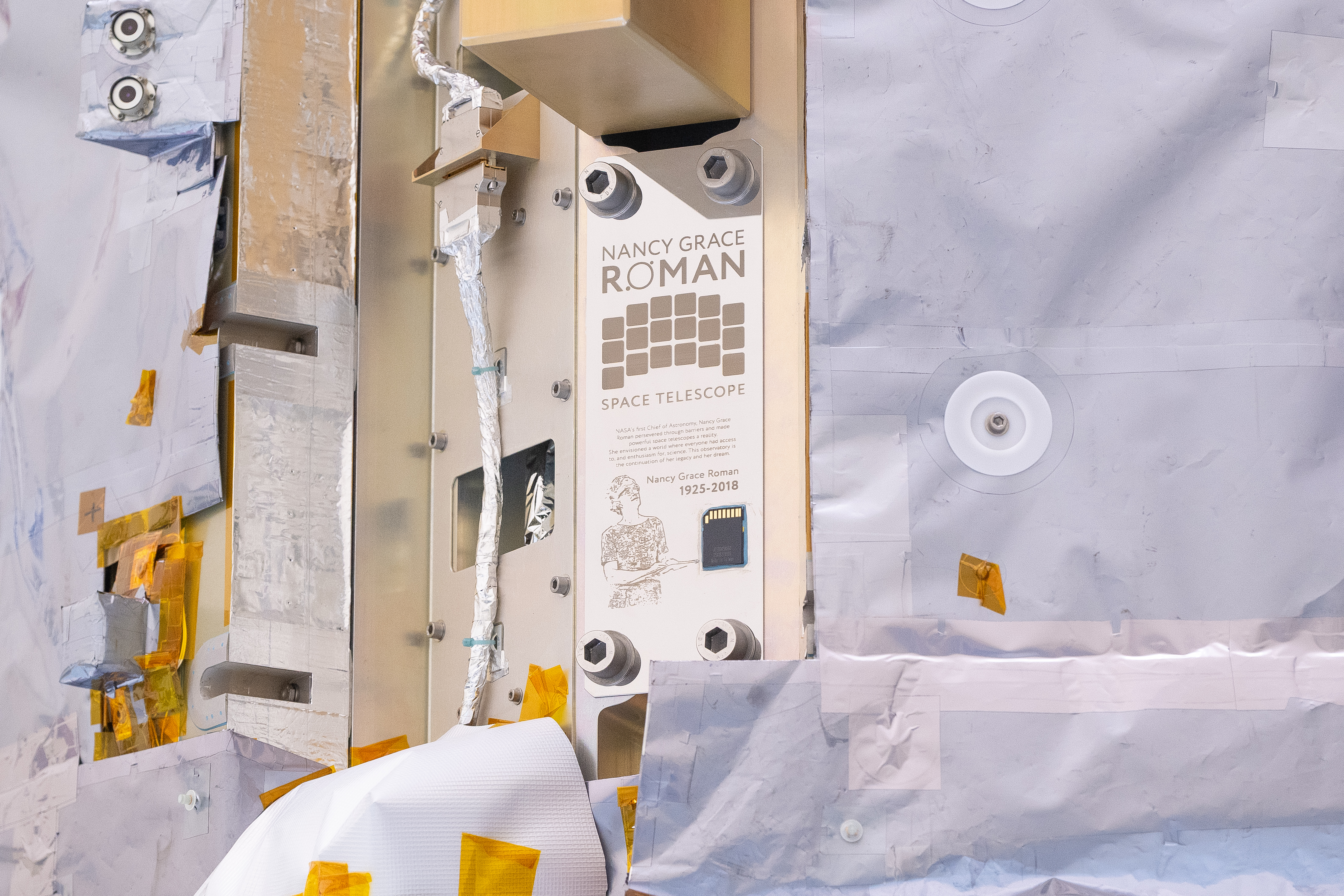
Technicians at NASA’s Goddard Space Flight Center attached a plaque to the Nancy Grace Roman Space Telescope on July 28, 2026, marking a milestone ahead of its scheduled launch. The plaque commemorates Dr. Nancy Grace Roman, NASA’s first chief astronomer and a key figure in developing the agency’s science initiatives. It also includes a memory card with 1,350,144 names collected from public submissions worldwide, including astronauts assigned to NASA’s Artemis II and Artemis III missions.
The Roman Space Telescope, set to launch on August 30, 2026, is designed to study exoplanets and planet-forming disks by blocking starlight to observe them directly. Its instruments will conduct a statistical census of planetary systems within the Milky Way, providing data on the prevalence and diversity of such systems.
Scientific objectives include investigating dark energy, which is accelerating the universe’s expansion, and addressing fundamental questions in infrared astrophysics. The telescope’s capabilities aim to enhance understanding of cosmic evolution and the structure of the universe.
The observatory represents a continuation of NASA’s legacy in space-based astronomy, following missions such as the Hubble and James Webb Space Telescopes. Its planned operations will contribute to multiple fields, including exoplanet research and cosmology, with data expected to inform future missions and scientific discoveries.