Payment Gateway Callback URL: Why Yours Went Quiet
CoinGate introduced two API endpoints to debug silent payment callbacks, replacing manual log analysis with direct API queries for faster troubleshooting.
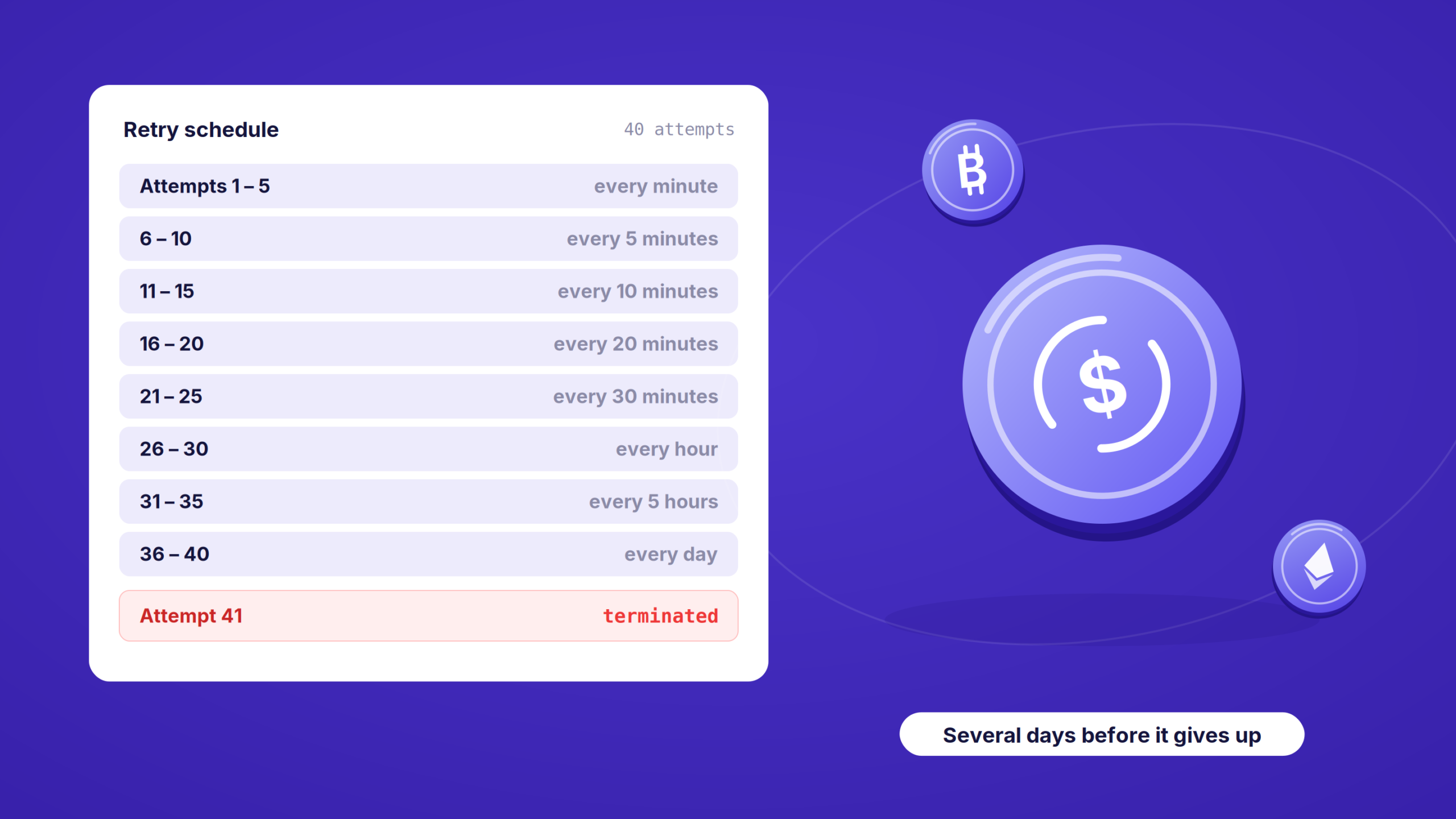
CoinGate’s new API endpoints, GET /v2/api_callbacks and GET /v2/api_callbacks/{id}/retries, allow merchants to verify whether a callback was attempted and inspect each attempt’s response status and payload. These endpoints replace time-consuming log reviews by providing structured data on callback attempts, retries, and failures. The tools are designed for scenarios where basic callback handling is already implemented but issues persist, enabling precise diagnosis without opening support tickets.
Callback failures often stem from endpoint misconfigurations, such as redirects or authentication challenges, which terminate delivery rather than triggering retries. CoinGate’s retry ladder spans up to 40 attempts over days, with final attempts spaced a day apart, meaning a callback may still be in transit even after hours of inactivity. Merchants should avoid manual order fulfillment until confirming the callback’s status via the API, as premature actions risk duplicate processing or customer disputes.
The GET /v2/api_callbacks endpoint filters callbacks by resource type (e.g., Order, Billing::Payment) and status, returning a paginated list with key fields like retries and status. A status of 'retrying' indicates an active attempt, while 'failed' or 'terminated' signals unrecoverable issues. The companion endpoint, GET /v2/api_callbacks/{id}/retries, provides granular details for each attempt, including the HTTP response code returned by the merchant’s server and the masked payload sent by CoinGate. This data helps distinguish between handler errors (e.g., 500 responses) and infrastructure issues (e.g., 404 or 403 errors).
To proactively monitor callbacks, merchants can poll GET /v2/api_callbacks on a schedule, filtering for failures or high retry counts, and set up alerts for prolonged issues. The same approach applies to all callback-enabled resources, including payouts, refunds, and recurring billing. For testing, CoinGate’s dashboard offers a resend tool under API Management, but it only replays the latest payload for a paid order—custom payloads require external tools like curl or Postman. Merchants should prioritize acknowledging callbacks immediately and deferring heavy processing to prevent system overload.