Skild AI Taps NVIDIA Physical AI to Teach Robots New Tasks From a Single Video
Skild AI’s new S1 robot model learns complex tasks from a single video demonstration using NVIDIA’s AI tools, enabling rapid adaptation without retraining and improving success rates in industrial settings.
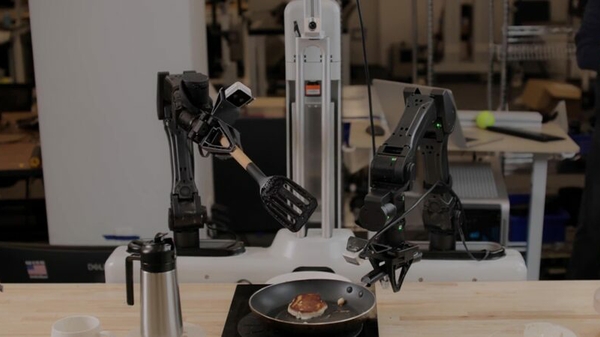
Manufacturing and warehouse environments frequently change, requiring robots to adapt to new tasks without extensive reprogramming. Skild AI’s S1 robot foundation model addresses this by learning previously unseen, long-horizon tasks from a single video demonstration, using a technique called in-context learning. The model interprets the demonstrated intent, objects, and sequence to map actions for the robot without updating its weights or undergoing task-specific post-training. This approach aims to reduce the need for constant retraining as tasks, layouts, or products evolve in dynamic workplaces.
Skild AI built the S1 model and conducted research on NVIDIA AI infrastructure, collaborating on synthetic data generation, model training, simulation, and real-world deployment. The companies are working to transition adaptable robot intelligence from labs to factories and other operational environments. Skild’s S1 can perform unfamiliar tasks lasting up to 10 minutes, including plant potting, pancake making, and kit assembly, often requiring dozens of manipulation steps. In tests, S1 succeeded about 66% of the time per step on new multistep tasks, a more than sevenfold improvement over a similar AI system.
The S1 model can adjust when objects move, recover from errors, and combine skills in sequences not explicitly programmed. Skild estimates that one short video example can be as effective as roughly 380 hands-on training examples, saving significant time compared to manual data collection. Operators can demonstrate new tasks directly without requiring a new dataset or training run for every change, breaking the cycle of constant retraining for robots in dynamic environments.
Skild and NVIDIA are deploying the Skild Brain on dual-arm manipulators for high-precision assembly of NVIDIA Blackwell systems, demonstrating tasks like installing components and adapting to disturbances. The collaboration leverages NVIDIA’s Isaac Lab, Cosmos, Omniverse, and TensorRT tools to train, simulate, and optimize robot performance. Skild also uses NVIDIA’s open simulation frameworks and reinforcement learning to reduce the simulation-to-reality gap and improve real-world adaptability.