“답하는 AI에서 일하는 AI로”… A.X K2가 그리는 소버린 AI의 미래 – 김태윤 파운데이션 모델 담당 인터뷰
SK Telecom unveiled A.X K2, a 688-billion-parameter foundation model, with improved reasoning, Korean-language knowledge, and agent capabilities. The model introduces a vision-language model and audio models for broader industrial and office use.
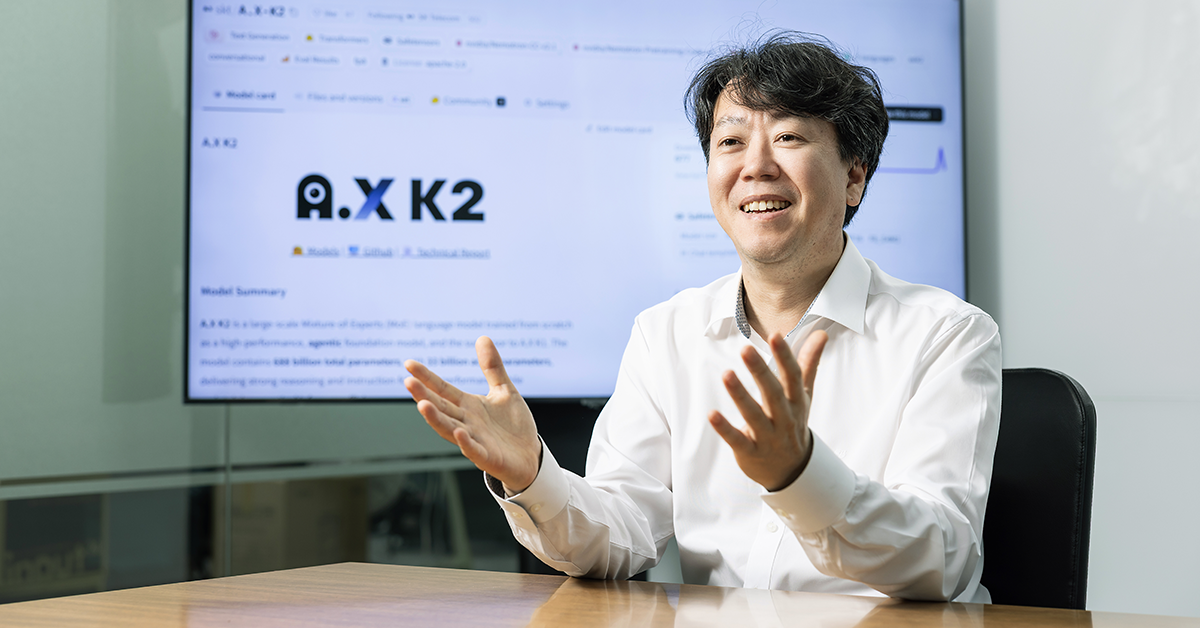
SK Telecom introduced its proprietary foundation model A.X K2, featuring 688 billion parameters, which enhances mathematical and scientific reasoning, Korean-language knowledge, long-form comprehension, and agent capabilities compared to its predecessor A.X K1. Performance across 14 international benchmarks improved by an average of 32.2 percentage points, with long-form comprehension and agent-related evaluations showing an 83.9 percentage-point increase. The company also launched a vision-language model for image-text understanding and audio models for speech recognition and analysis, aiming to expand AI applications into manufacturing, defense, biotech, offices, and daily life.
Kim Tae-yoon, head of SKT’s foundation model team, highlighted A.X K2’s shift from a question-answering AI to one capable of planning and executing tasks autonomously. The model achieved a score of 45.8 on the Apex mathematics benchmark, up from 1.0 in A.X K1, and recorded 97.1 on AIME26, placing it among the top open-weight models globally. Korean-language evaluations showed strong results, with KMMLU-Pro at 80.5 and CLIcK at 91.6. Despite its larger scale, A.X K2 maintains efficient inference by activating only 33 billion parameters during reasoning, achieved through high-quality data, proprietary architecture, and refined post-training techniques.
The model’s Sparse Gated Attention (SGA) architecture enables efficient processing of long contexts, such as reports or lengthy documents, improving throughput and latency. For inputs exceeding 120,000 tokens, A.X K2 processes 67.7% more tokens than A.X K1, addressing the demands of agentic workflows that involve multiple tool calls and extended dialogues. SKT also developed derivative models, including A.X K2 VL Light-Preview for vision-language tasks and A.X K2 ALM and A.X K2 Raon-Speech for audio applications, to support multimodal industrial use cases.
The performance gains in A.X K2 stem from a focus on data quality, proprietary architecture, and targeted investments in high-difficulty reasoning, Korean-language proficiency, and industry-specific knowledge. SKT is piloting the model with manufacturing firms like KG Steel and Conex to validate its use in defect analysis and troubleshooting. For defense and other security-sensitive sectors, A.X K2 will be quantized for on-premises deployment to ensure data sovereignty and compliance with strict security protocols.