Advancing the Royal Navy's mine-hunting capability
The UK Defence Science and Technology Laboratory (Dstl) supported a two-day naval exercise to test mine-hunting capabilities, identifying design changes for future support vessels and informing procurement decisions.
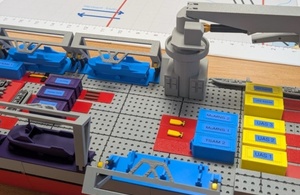
The Defence Science and Technology Laboratory (Dstl) collaborated with Naval Design Partnering (NDP), the Ministry of Defence, and Royal Navy stakeholders to conduct a high-profile table-top exercise assessing the UK’s Mine Hunting Capability (MHC). With only two weeks’ notice, Dstl mobilised analysts to design realistic mine countermeasure scenarios, enabling Royal Navy experts to test operational concepts under simulated conditions. The exercise focused on addressing the persistent threat posed by underwater mines, which can disrupt trade routes and military operations. Dstl’s rapid response ensured the Royal Navy could evaluate mine-hunting strategies against evolving threats.
Dstl provided specialist guidance to develop operationally relevant scenarios and real-time advice during the two-day exercise. Analysts generated evidence-based insights into mine-hunting performance in real-world environments, identifying a critical design change for an offshore support vessel (OSV) from Norway. This change aims to enhance the UK’s future mine-hunting mother ship capability. The findings will directly inform procurement decisions, reducing risks associated with major investments in mine countermeasure systems.
Using a large-scale 3D printed model created by NDP, Dstl facilitated the exploration of deck operations for future mine-hunting mother ship designs. The modelling allowed stakeholders to visualise and assess integration challenges and operational frictions before finalising costly design choices. This approach enabled early identification of potential solutions, streamlining decision-making and reducing planned expenditure. The exercise demonstrated the value of combining traditional methods with innovative tools to address complex defence challenges.
Dstl’s support has accelerated engagement between the UK and Norwegian governments, clarifying requirements and reducing procurement uncertainty. The collaboration between DE&S, Dstl, NDP, and Royal Navy stakeholders has strengthened the UK’s mine-hunting capability by providing evidence-based insights. This work underscores Dstl’s role in de-risking significant defence investments and safeguarding operational effectiveness through scientific and technical leadership.