GRETA Comes Online for a New Era of Nuclear Science
The Gamma-Ray Energy Tracking Array (GRETA) has begun operations at Michigan State University’s Facility for Rare Isotope Beams, enabling unprecedented observations of atomic nuclei using high-purity germanium detectors.
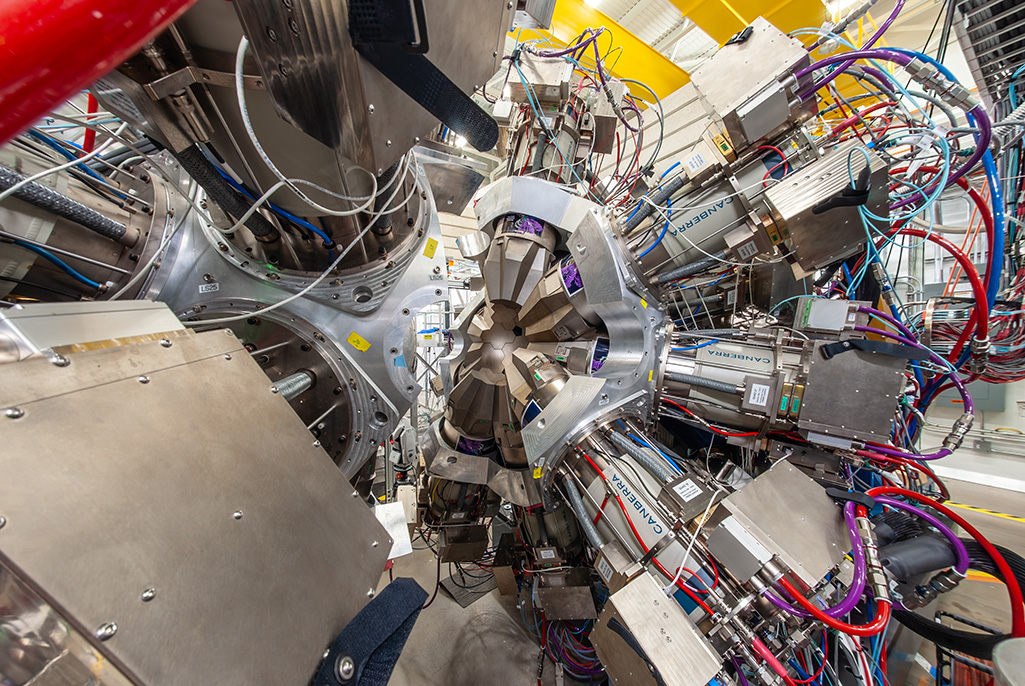
The Gamma-Ray Energy Tracking Array (GRETA), a next-generation gamma-ray spectrometer, has successfully completed its initial commissioning and characterization run at the Facility for Rare Isotope Beams (FRIB) at Michigan State University. The detector, which uses high-purity germanium technology, is designed to observe atomic nuclei with greater sensitivity and precision than previously possible. GRETA was assembled in stages at Lawrence Berkeley National Laboratory before being installed at FRIB in late 2025, marking the end of years of collaborative development by teams from multiple national laboratories and universities.
During commissioning, researchers integrated GRETA with FRIB’s ReAccelerator beamline, calibrating its systems and collecting experimental data to confirm its performance. In the characterization phase, scientists collided lighter nuclei to create excited nuclei that decayed, emitting cascades of gamma rays detected by GRETA. The collaboration now plans to use the detector for upcoming experiments at FRIB, a Department of Energy user facility supporting researchers worldwide.
GRETA’s capabilities will allow scientists to study how nuclei are structured, their limits in holding protons or neutrons, and their behavior under extreme conditions. The detector will also aid research into the formation of heavy elements in stellar environments and the search for subtle asymmetries that may explain the dominance of matter over antimatter in the universe.
The measurements enabled by GRETA are expected to refine theoretical models of atomic nuclei, with applications spanning nuclear physics, astrophysics, energy, medicine, and national security. The project is led by Lawrence Berkeley National Laboratory, with contributions from FRIB, Argonne National Laboratory, and Oak Ridge National Laboratory, under the U.S. Department of Energy’s Office of Science.