New MatterChat Model Helps AI to ‘See’ the Language of Science
Berkeley Lab’s MatterChat bridges large language models with physics-based AI to interpret atomic-scale data, enabling faster and more accurate materials science predictions.
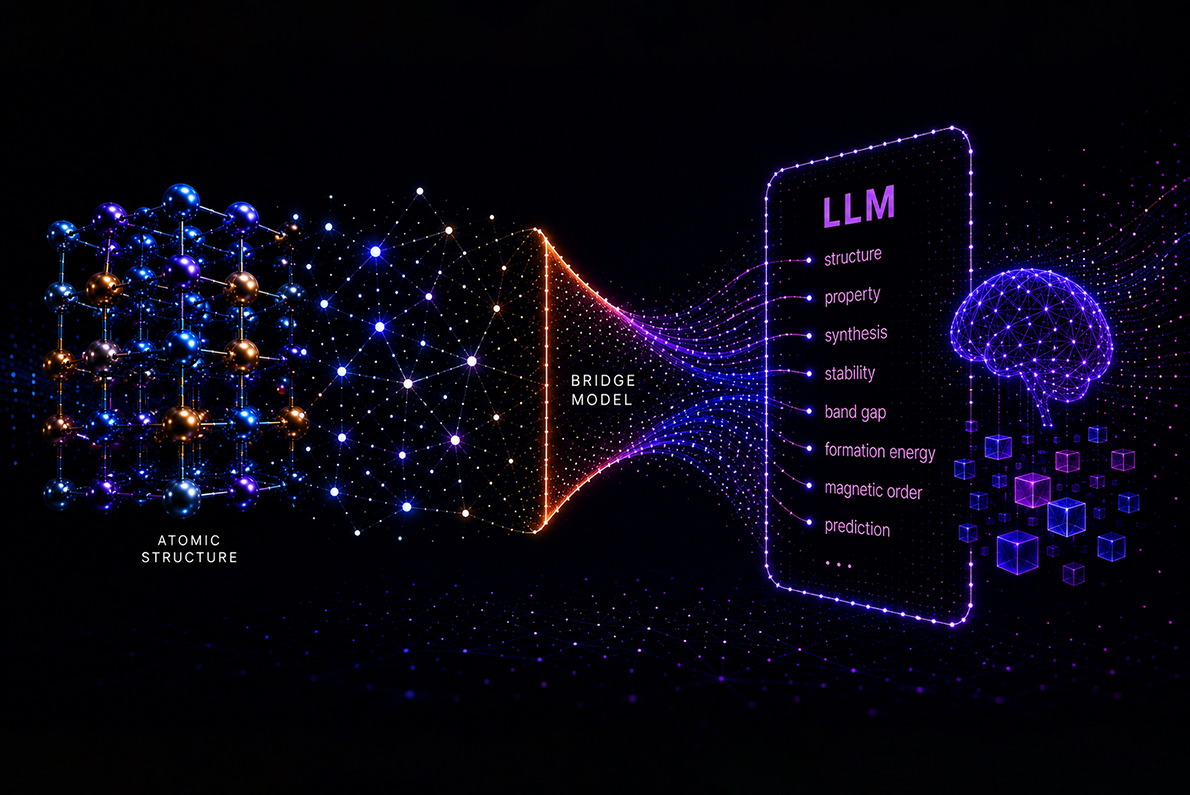
Traditional AI excels at text but struggles with the three-dimensional data central to materials science, where atomic interactions determine a material’s properties. Berkeley Lab’s MatterChat addresses this gap by linking a large language model (LLM) with a physics-based AI that models interatomic forces, effectively giving the LLM a structural understanding of atomic arrangements. The framework was trained on 143,000 stable atomic structures from the Materials Project, focusing on properties like formation energy and bandgap critical for electronics. This approach allows researchers to query the model in natural language while receiving scientifically grounded insights, bridging the divide between textual and physical data representations.
The team validated MatterChat by comparing its performance against general-purpose LLMs and specialized scientific AI tools across tasks such as material classification and property prediction. In benchmarks, MatterChat demonstrated superior accuracy, particularly in predicting bandgaps, a key factor in designing advanced electronics and energy storage systems. Unlike models requiring extensive retraining, MatterChat leverages pre-trained components—a structural encoder for materials physics and an open-source LLM—connecting them via a lightweight bridge model. This modular design reduces computational costs while enabling future upgrades or adaptations to other scientific domains.
MatterChat’s development was supported by Berkeley Lab’s Laboratory Directed Research & Development program and supercomputing resources at NERSC, including access to the Perlmutter supercomputer. The project now extends into a collaboration with Fermilab’s AXESS mission, which aims to accelerate the development of radiation-hardened detectors for particle physics experiments using AI-driven analysis. The framework’s forward-compatible design positions it to integrate advancements in LLMs and new scientific data, ensuring long-term relevance in evolving research landscapes.
Co-authors highlighted the significance of MatterChat’s approach, noting that it transforms LLMs into practical research tools by embedding scientific inductive biases—aligning textual descriptions with physical realities. The work underscores Berkeley Lab’s role in advancing specialized AI for science, focusing on connective frameworks rather than competing with large-scale commercial models. With applications spanning materials discovery and beyond, MatterChat represents a step toward more efficient, interpretable, and domain-specific AI systems in scientific research.