APOD: 2026 November 11 – NGC 4449: Small Galaxy, Big Impact
NASA’s Astronomy Picture of the Day highlights NGC 4449, a dwarf galaxy whose stellar winds and supernovae may distribute heavy elements across the universe.
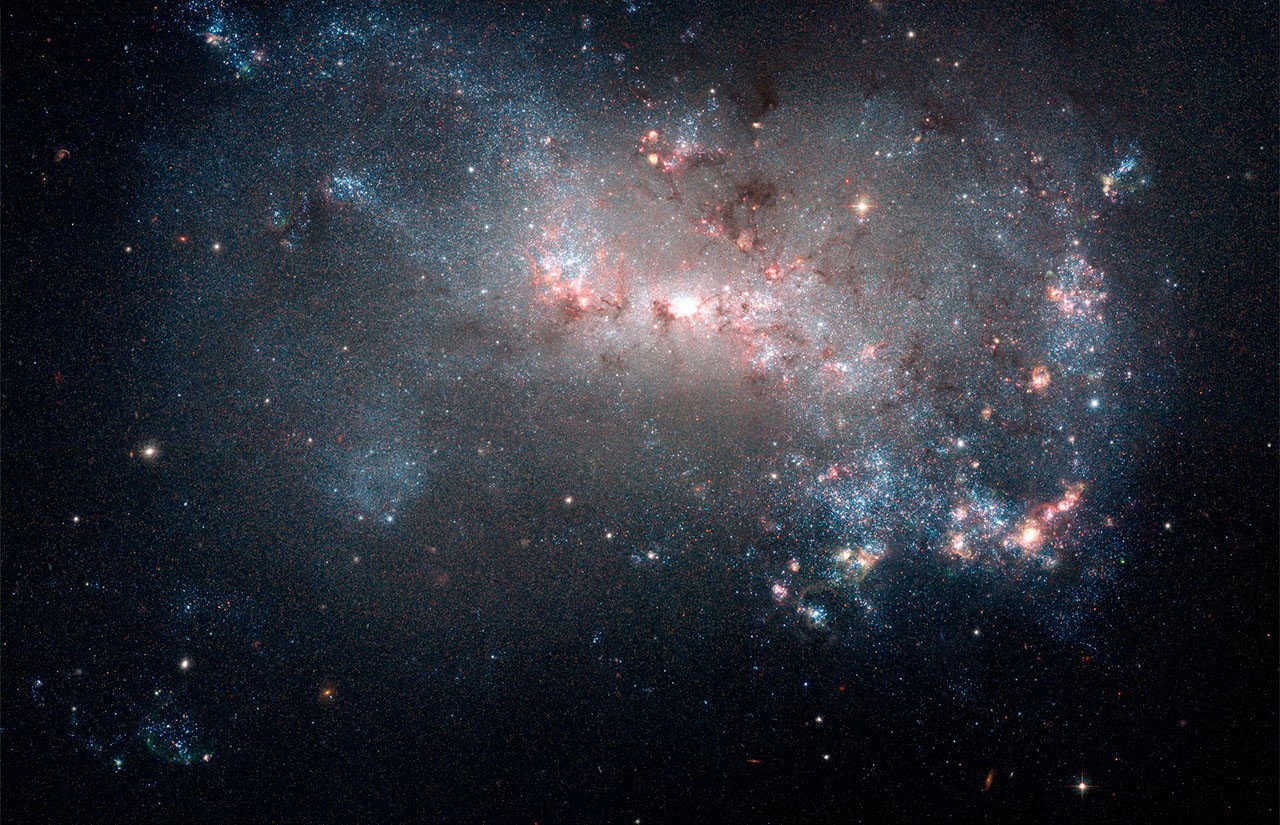
The Milky Way spans about 100,000 light years and contains hundreds of billions of stars, dwarf galaxies like NGC 4449 are far smaller yet more common. These galaxies, roughly one-tenth the size of the Milky Way, hold only a few billion stars each. Despite their modest scale, dwarf galaxies are critical to understanding cosmic chemical evolution. Their low oxygen levels suggest intense stellar winds and supernovae are expelling heavy elements into space.
NGC 4449, featured in today’s image, was captured by the Hubble Space Telescope, revealing its irregular structure and active star formation. The galaxy’s deficit in oxygen challenges existing models of stellar feedback in small systems. Researchers propose these outflows may enrich intergalactic space with elements essential for future star and planet formation.
Astronomers note that dwarf galaxies like NGC 4449 contribute disproportionately to the distribution of heavy elements across the cosmos. Their frequent supernovae and stellar winds act as cosmic engines, dispersing carbon, oxygen, and iron beyond their boundaries. This process plays a key role in the chemical enrichment of the early universe.
The image underscores the importance of dwarf galaxies in galactic ecology, despite their diminutive size. By studying NGC 4449, scientists gain insights into how small systems shape the broader universe. Tomorrow’s featured image will highlight a significant date in Poland.