APOD: 2026 November 2 – A Long Cloud on Mars
A rare, recurring water-ice cloud stretching over 1,500 kilometers forms above Mars’ Arsia Mons volcano during local spring and summer mornings, defying typical dust-driven cloud formation processes.
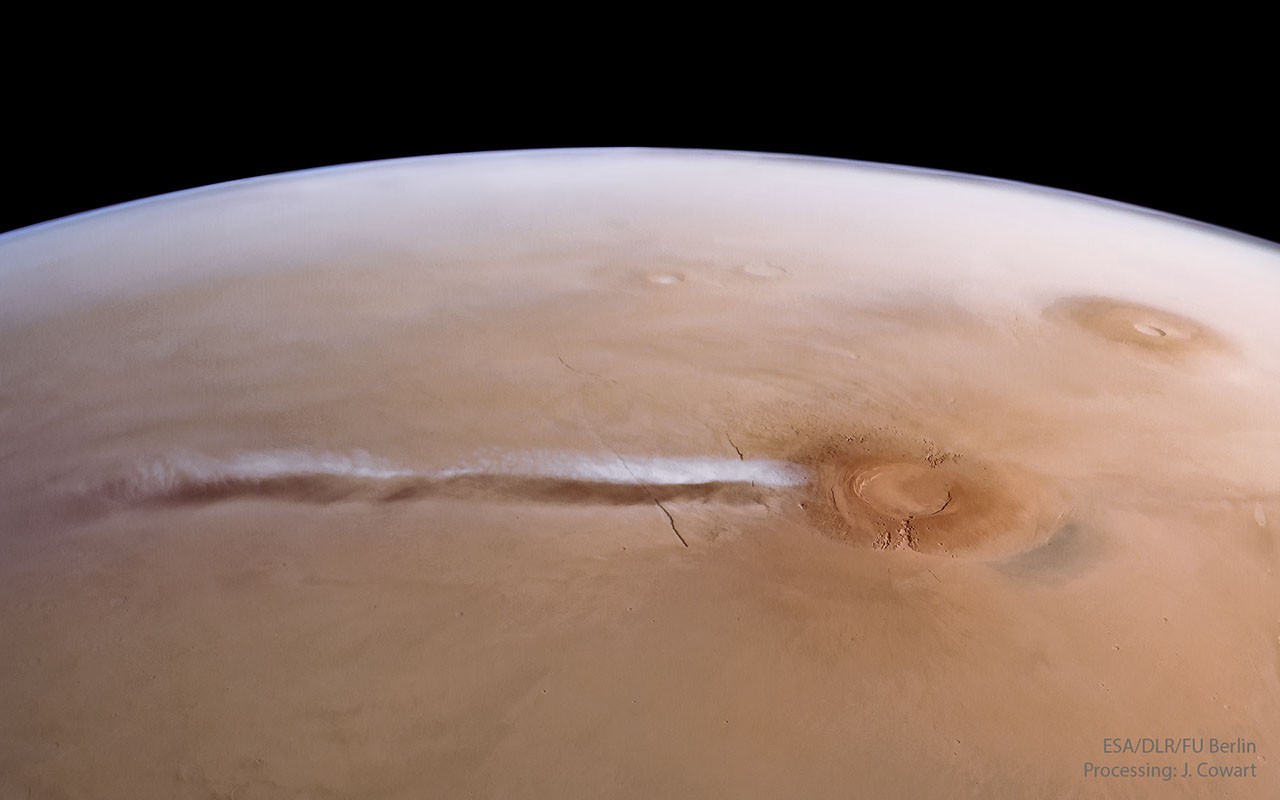
A long, water-ice cloud has been observed forming above Mars’ Arsia Mons volcano, a phenomenon first documented by NASA’s Viking Orbiter 2 in 1977. The cloud appears seasonally during spring and summer on Mars, typically visible only in the morning hours. Recent imaging by ESA’s Mars Express spacecraft has provided more detailed views of this unusual feature. Researchers note that the cloud’s formation does not follow the usual pattern of dust particles seeding ice crystals in the thin Martian atmosphere.
The cloud originates near Arsia Mons, a massive shield volcano on Mars, and is carried downstream by winds, creating an elongated tail that can extend over 1,500 kilometers. This tail gives the cloud its distinctive appearance, resembling a long, thin streak across the Martian sky. The phenomenon is seasonal, disappearing and reappearing in sync with Mars’ climate cycles. Scientists continue to study the cloud to understand its formation and behavior.
Unlike typical Martian clouds, which rely on dust for ice crystal formation, the Arsia Mons Elongated Cloud (AMEC) appears to form without this mechanism. This challenges existing models of cloud formation on Mars and raises questions about atmospheric processes in the planet’s thin, dust-poor upper layers. The cloud’s seasonal timing and location suggest a connection to local atmospheric dynamics around the volcano.
Researchers hope that studying AMEC will improve understanding of cloud formation not only on Mars but also on Earth. By analyzing this unique phenomenon, scientists aim to refine models of atmospheric behavior across different planetary environments. The ongoing observations by Mars Express and other missions contribute valuable data to this effort.