COSI Telescope Comes Together
NASA-supported COSI gamma-ray telescope assembly completed at UC Berkeley, marking a milestone for studying cosmic antimatter and stellar explosions.
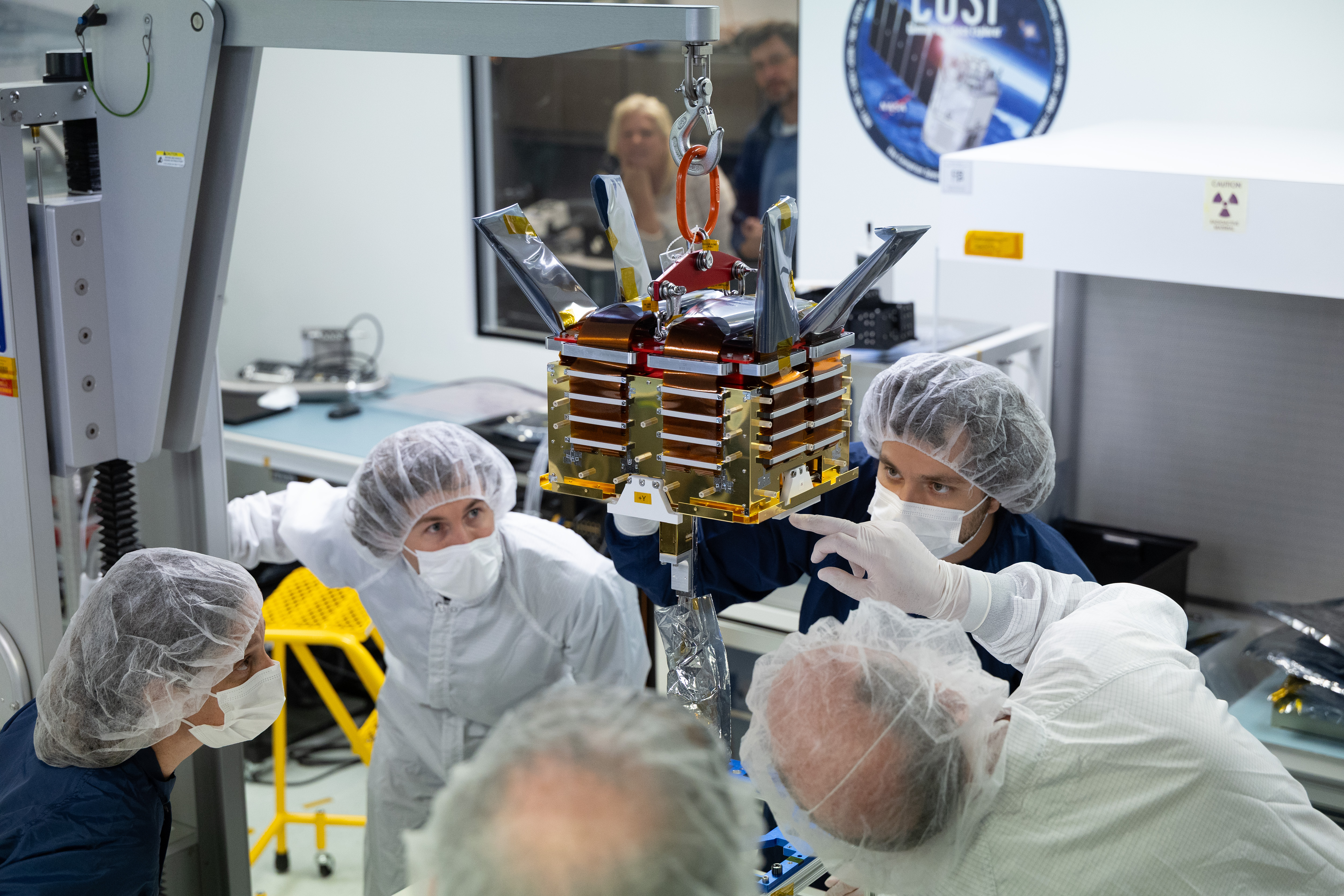
Engineers at the University of California, Berkeley’s Space Sciences Laboratory completed assembly of the COSI (Compton Spectrometer and Imager) telescope on July 8, 2026. The detector assembly, featuring silver-covered flex circuits for signal transmission, was carefully lifted during the milestone event. COSI is designed to observe gamma rays across the Milky Way and beyond, focusing on antimatter interactions and stellar life cycles. The project represents a multi-institutional collaboration spanning academic, government, and international partners.
The telescope’s wide-field gamma-ray capabilities will enable scientists to investigate energetic cosmic phenomena with greater precision. Researchers aim to analyze matter-antimatter interactions and the explosive endpoints of massive stars. The detector’s assembly marks a critical step toward its planned scientific operations in orbit. COSI’s design incorporates advanced signal readout electronics to capture high-energy gamma-ray events.
The COSI mission is led by the University of California, Berkeley’s Space Sciences Laboratory in partnership with multiple institutions. Collaborators include the University of California, San Diego; the Naval Research Laboratory; NASA’s Goddard Space Flight Center; and Northrop Grumman. Additional contributions come from the Space Dynamics Laboratory, the Italian Space Agency, and other research entities.
Once operational, COSI will join NASA’s fleet of space telescopes dedicated to high-energy astrophysics. The telescope’s observations are expected to provide new insights into the lifecycle of stars and the dynamics of antimatter in the universe. The completed assembly paves the way for integration with a spacecraft and eventual launch.