Curiosity Blog, Sols 4975-4981: Happy 14th Landing Anniversary
NASA’s Curiosity rover marked its 14th Earth-year anniversary on Mars with routine science operations, including arm deployment and rock analysis at a layered outcrop near the landing site.
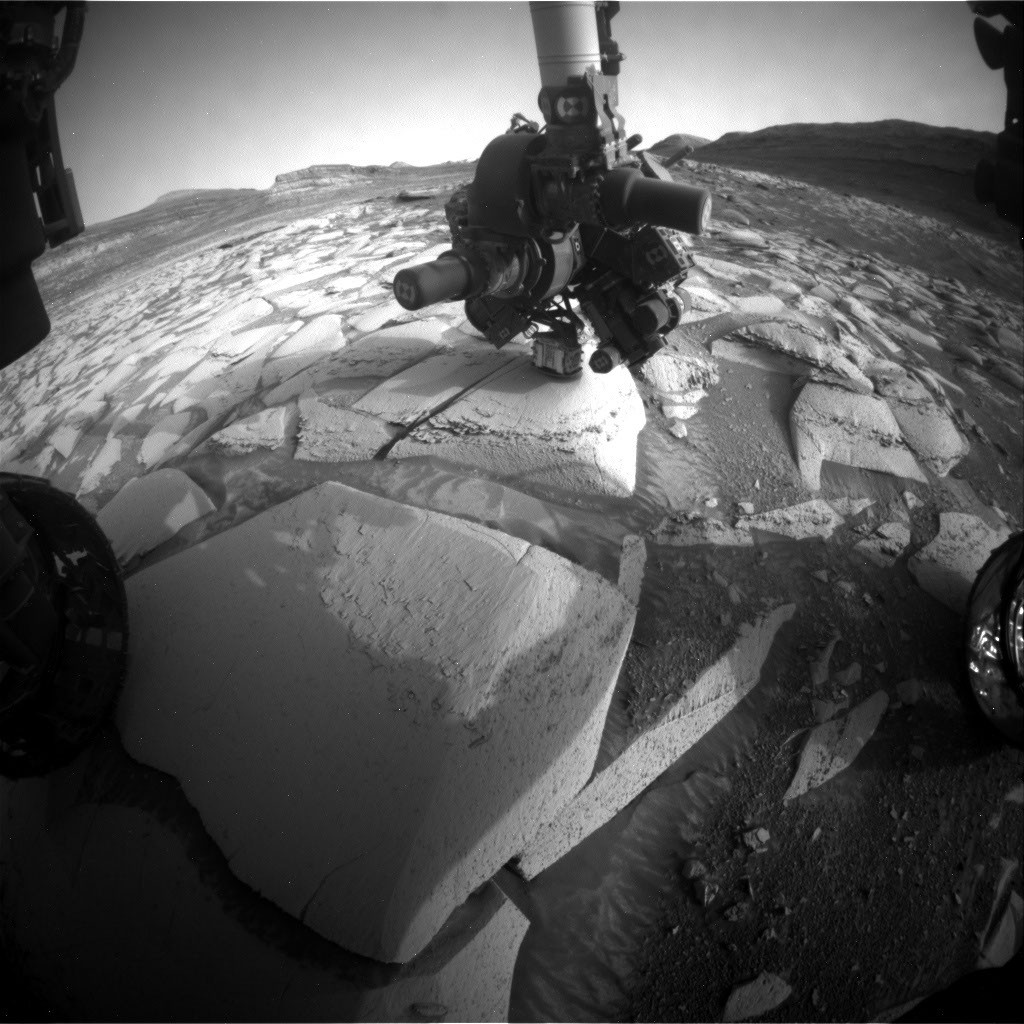
NASA’s Curiosity team celebrated the rover’s 14th landing anniversary on Mars, reflecting on the mission’s longevity and scientific achievements since its touchdown on August 6, 2012. The rover continued standard operations, deploying its arm on Sol 4976 to perform an APXS measurement at the target "Tunas Khasa," positioned at a geologically significant site where two rock layers intersect. The team also conducted a 46-foot drive to reach an area featuring cross-bedded rocks truncated by other layers, providing clues about past environmental conditions involving wind and water activity.
On the anniversary week, Curiosity focused on detailed imaging and analysis of the layered outcrop "Tres Morros," capturing a high-resolution mosaic using the MAHLI instrument. Mastcam documented representative outcrops, including targets "Laguna Del Eulogio" and "Laguna de Pozuelo," to study changes in rock layers and stratigraphy near the butte "Mishe Mokwa," a previously documented geological feature. ChemCam analyzed targets "Rio Tranquilo" and "Rio Juncalito" to investigate water-related formations and cross-bedded structures, while also capturing remote micro-imager (RMI) views of "Valle Grande" and "Mishe Mokwa."
The rover’s science plan included environmental monitoring, such as dust-devil surveys, atmospheric opacity measurements, wind monitoring, and cloud observations. The RAD instrument, active since launch, continued measuring radiation levels throughout the week, contributing long-term data on the Martian surface environment. These routine activities underscore Curiosity’s ongoing role in assessing habitability and past conditions on Mars.
Curiosity’s mission remains focused on piecing together Mars’ geological history by examining layered rock formations and sedimentary structures. The rover’s extended operations at scientifically rich sites like the current location allow researchers to refine their understanding of the planet’s ancient climate and potential for past microbial life. The team plans to extend their stay at this site through Monday, utilizing two additional planning cycles for further analysis.