Big highs and lows across Asia in September
Asia’s solar irradiance in September swung widely, with Japan and Borneo 70% below normal while parts of China, Korea and the Philippines were up to 30% above, driven by typhoons and wildfire smoke.
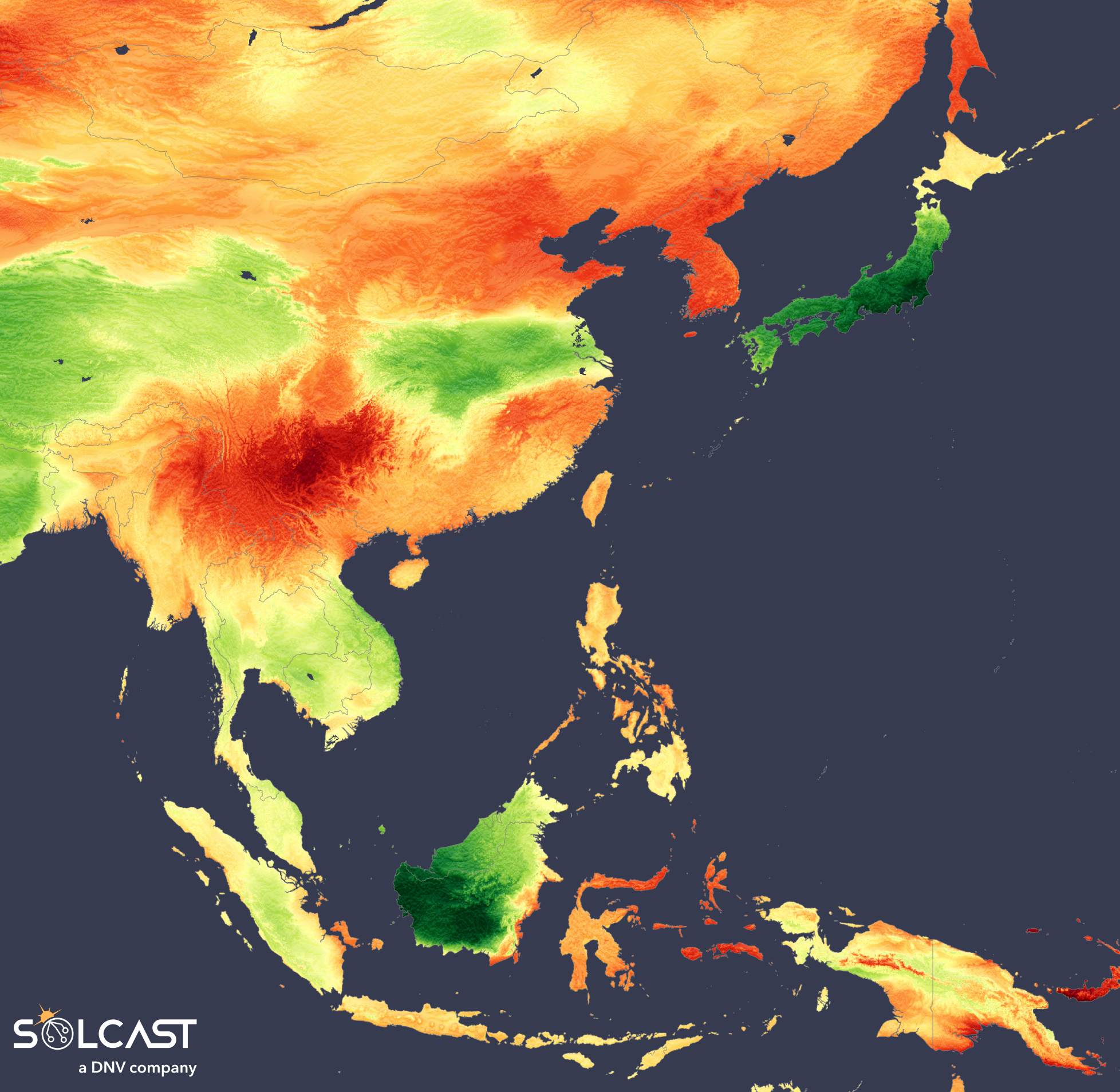
September brought unusually large swings in solar irradiance across Asia, with few regions experiencing a typical month and some areas around 30% above or below normal breaking records, according to analysis using the Solcast API. Japan and Borneo were notably cloudier, while parts of China, Korea, the Philippines and eastern Indonesia recorded much sunnier conditions. An active typhoon season contributed to the sharp contrasts, while the outlook for the final three months of 2026 remains brighter across much of Southeast Asia and cloudier in parts of eastern China and Japan as El Niño continues to strengthen.
Japan and Borneo experienced notably below-average irradiance in September with both close to 70% of normal. Japan suffered under a tropical storm and typhoons which each brought extensive cloud, while Borneo was affected by wildfire smoke followed by stronger cloud cover later in the month. In contrast, northern China, Korea, the Philippines and eastern Indonesia recorded substantially above-average irradiance. The Yunnan-Guizhou Plateau in southern China saw particularly strong positive anomalies, reaching up to 30% above normal, the greatest increase across Asia.
September continued an already active 2026 typhoon season, with three typhoons, Dujuan, Surigae and Choi-wan. Extreme sea surface temperatures have contributed to the particularly active season. Dujuan and Surigae impacted the Japanese islands in close succession, consistent with the substantial irradiance reductions observed there. Less powerful tropical storms and depressions also brought extensive cloud and rainfall across parts of the region, particularly Vietnam, Thailand and Japan, further suppressing irradiance during affected periods.
Solcast produces these figures by tracking clouds and aerosols at 1-2km resolution globally, using satellite data and proprietary AI/ML algorithms. This data is used to drive irradiance models, enabling Solcast to calculate irradiance at high resolution, with typical bias of less than 2%, and also cloud-tracking forecasts. This data is used by more than 350 companies managing over 350 GW of solar assets globally.