Leapting launches autonomous forklift for solar module transport
Leapting introduces an autonomous forklift designed to transport solar modules weighing up to 3,000 kg at utility-scale solar sites using GPS-RTK, LiDAR, and 3D vision for navigation and obstacle avoidance.
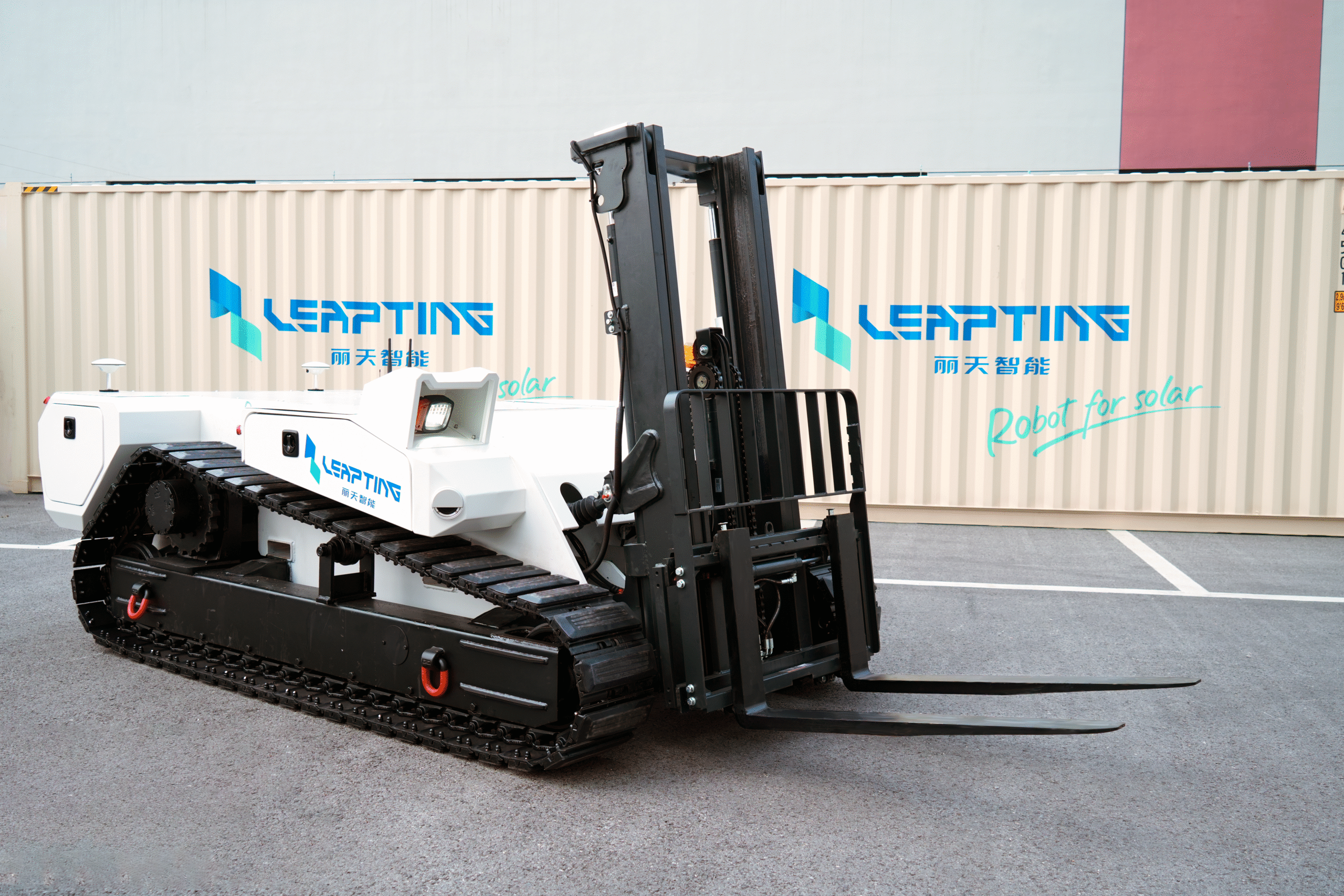
Leapting, a Chinese developer of robotic automation for the PV industry, has launched the Auto-Navigation Forklift Robot (AFR), an autonomous forklift engineered for utility-scale solar construction. The system can transport pallets of solar modules weighing up to 3,000 kg from laydown yards to installation rows without a human operator. The AFR integrates GPS-RTK, laser-based SLAM, and 3D computer vision to locate pallets, identify fork-hole coordinates in real time, and auto-plan insertion paths, according to the company.
The forklift features 360-degree multi-line LiDAR, intelligent obstacle avoidance, and a three-tier braking system for safety. It measures 4.8 m × 1.8 m × 2.15 m, weighs 5,500 kg, and has a maximum lifting height of 3 m. The tracked chassis, powered by two independently driven 4 kW motors, reaches speeds of up to 3 km/h when fully loaded and 4 km/h when unloaded, with differential track steering enabling on-the-spot rotation.
The AFR is equipped with a 48 V, 400 Ah lithium battery providing 19.2 kWh of energy and at least eight hours of operation under standard conditions. It supports automatic and manual fast charging via AC 220 V and AC 380 V connections. The system can operate in fully autonomous, semi-automatic, or manual remote-control modes, with safety features including multi-line LiDAR sensors, audible and visual warnings, and a three-tier braking system.
The forklift is designed for diverse terrains, including hard roads, desert, gravel, and lightly uneven or muddy ground, with a maximum wading depth of 0.3 m and the ability to negotiate gradients of at least 30 degrees on hard surfaces. It has an operating temperature range of -10°C to 50°C and an IP67 ingress protection rating, depending on configuration.