‘Peace remains only a promise’ for millions in eastern DR Congo, General Assembly hears
The Prime Minister of the DRC told the UN General Assembly that global demand for minerals risks fueling conflict in eastern Congo, where millions remain displaced despite peace agreements and UN resolutions.
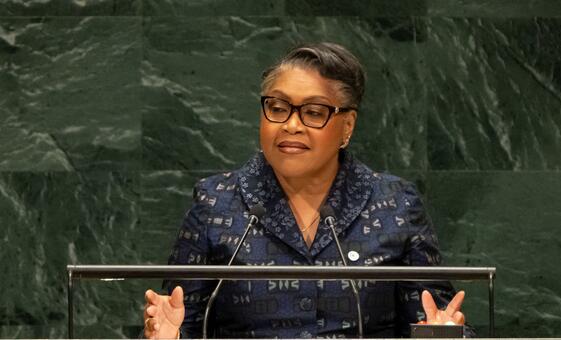
Prime Minister Judith Suminwa warned that rising global demand for minerals like cobalt and copper risks perpetuating violence in eastern Democratic Republic of the Congo, where decades of conflict and displacement persist. She criticized the pursuit of decarbonization through 'blood-stained minerals,' arguing that a just transition must not replicate exploitative past dependencies. Speaking at UN headquarters, she highlighted ongoing insecurity driven by armed groups, including Rwanda-backed M23 and others like ADF and CODECO, which exacerbate the humanitarian crisis.
Suminwa noted that while a peace agreement between the DRC and Rwanda in June 2025 and UN Security Council Resolution 2773 (2025) offer a path to peace, 'for millions of Congolese, this peace remains only a promise.' She emphasized the resolution’s call for an end to hostilities, withdrawal of Rwandan forces, and restoration of state authority, stressing the need for implementation rather than new agreements.
The Prime Minister also addressed the Democratic Forces for the Freedom of Rwanda (FDLR), citing a May protocol for disarmament and demobilization. She highlighted MONUSCO’s recent repatriation of 120 FDLR-associated individuals as an early step in implementing the agreement, though she did not specify further details about the process or outcomes.
Suminwa underscored the DRC’s role as the world’s largest cobalt producer and a major copper supplier, warning that current extraction models concentrate profits and technology outside producer countries. She called for building regional businesses to create jobs and shared prosperity, rejecting a model that limits the DRC to raw material extraction while others benefit from higher-value industries.