Roman Space Telescope Travels to SpaceX Hangar
NASA’s Roman Space Telescope has been moved to a SpaceX hangar at Kennedy Space Center ahead of its planned launch on a Falcon Heavy rocket no earlier than August 30, 2026.
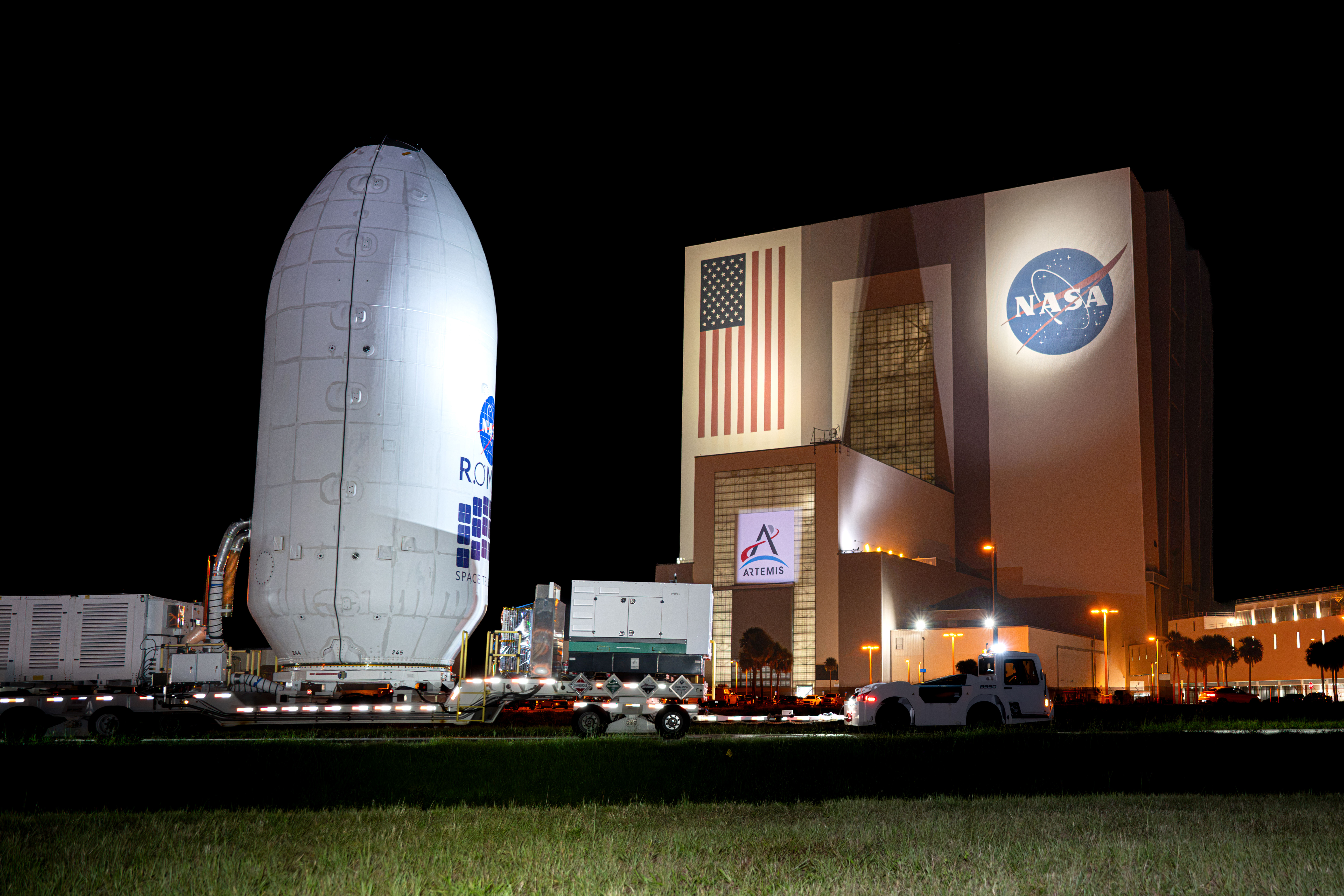
NASA’s Nancy Grace Roman Space Telescope, enclosed in its protective payload fairing, was transported from the Payload Hazardous Servicing Facility to a SpaceX hangar at Kennedy Space Center on August 25, 2026. The move marks a key step in preparing the observatory for integration with a SpaceX Falcon Heavy rocket ahead of launch. The telescope’s science instruments are designed to study dark energy, the force driving the universe’s accelerating expansion, and to map the distribution and evolution of galaxies influenced by dark matter.
The Roman Space Telescope’s primary objectives include investigating the nature of dark energy and dark matter, which together account for about 95% of the universe’s total mass and energy. By measuring the universe’s expansion history and the growth of cosmic structures, the mission aims to provide data that could reshape understanding of fundamental physics. The observatory will also conduct a wide-field survey to study galaxy formation and distribution over cosmic time.
The telescope is now positioned at Launch Complex 39A, where it will undergo final preparations for its scheduled launch no earlier than August 30, 2026. The integration with the Falcon Heavy rocket will follow standard procedures for payload mating, ensuring compatibility with the launch vehicle’s systems. This phase includes checks of electrical and mechanical interfaces to confirm readiness for flight.
Once operational, the Roman Space Telescope will operate from the second Lagrange point (L2), approximately 1.5 million kilometers from Earth, where it will conduct observations free from atmospheric interference. The mission is expected to operate for at least five years, collecting data that will complement and expand upon findings from previous space telescopes such as Hubble and James Webb.