Toward Self-Improving Agents
Salesforce highlights recursive self-improvement (RSI) as a key differentiator for enterprise AI agents, enabling automated learning from user interactions to enhance performance and reduce costs over time.
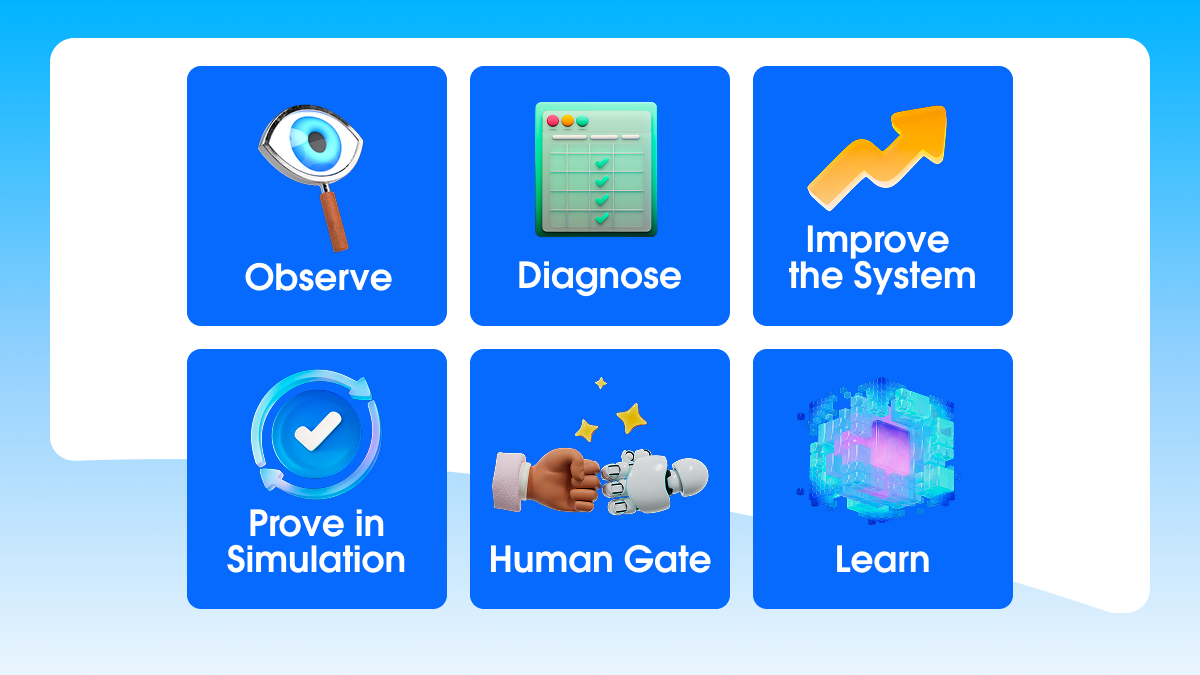
Salesforce argues that the next generation of AI agents will succeed not just because of advanced foundation models, but due to systems that continuously learn from their own outcomes. Agents equipped with governed self-improvement loops outperform static deployments, which rely on manual patches that struggle to keep pace with evolving usage patterns and model updates. The difference in performance and cost efficiency becomes apparent within months, as automated loops detect failures, diagnose root causes, and test improvements through simulations, optimizing both technical and business metrics.
The company notes that over 11 million Agentforce calls run daily, each session unique, making manual tuning impractical. Recursive self-improvement converts these varied tasks and outcomes into trustworthy upgrades, addressing limitations of static systems. Salesforce emphasizes that while foundation models improve rapidly and become cheaper, the durable value lies in the compounding improvements of the system around the model, not the model itself.
To implement RSI, enterprises must define success metrics such as accuracy, speed, cost, and business KPIs, along with guardrails for policy violations and regressions. Recent research suggests that simple methods like greedy hill climbing can match more complex optimization techniques while requiring fewer evaluations. The optimization engine measures performance, identifies issues, evolves configurations, and evaluates candidates through simulations, repeating the process to drive continuous improvement.
Salesforce explains that freezing the model’s weights does not limit an agent’s potential for improvement, as changes to prompts, tool configurations, workflow sequencing, and other system components can still yield significant gains. The company’s 2023 Retroformer demonstrated that reinforcement learning techniques could optimize frozen-weight agents by tuning prompts in response to new environments, achieving better results without model updates. This approach allows for faster, reversible experimentation, enabling systems to evolve more efficiently.