Digital Measuring Center: How Hyundai Motor and Kia Validate 1,000 Measurement Points on Every Vehicle
Hyundai Motor and Kia have opened a Digital Measuring Center at their Namyang R&D facility to validate 1,000 measurement points per vehicle, addressing subtle dimensional issues that affect quality, noise, and water tightness.
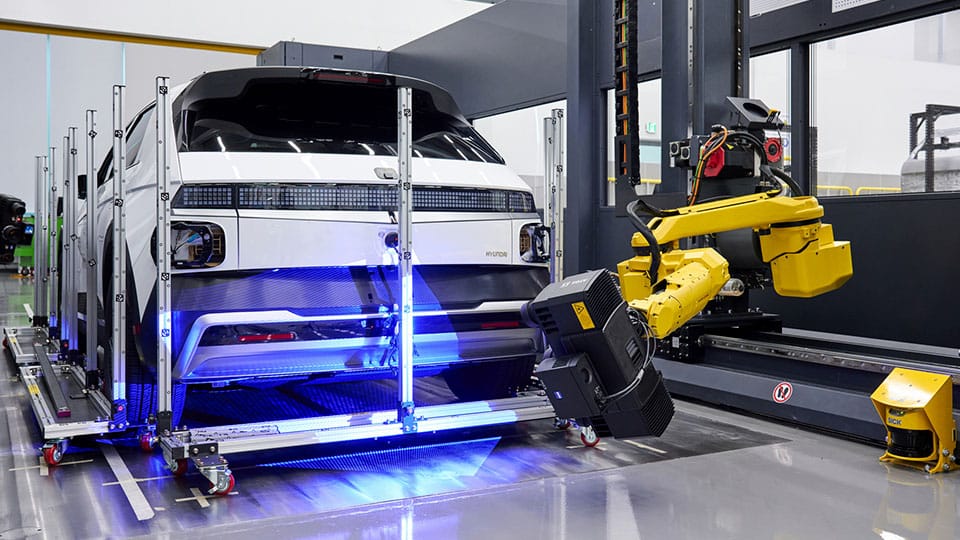
Hyundai Motor and Kia operate the Digital Measuring Center (DMC) at their Namyang R&D Center to detect minute dimensional variances in vehicle assembly that are often invisible to manual inspection. The facility uses Coordinate Measuring Machines (CMM) to scan up to 1,000 points per vehicle body, assessing 600 quality criteria across exterior quality, NVH, water tightness, and assembly feasibility. By identifying small gaps or deformations early, the DMC shifts quality control from reactive fixes to proactive data-driven refinement, ensuring tighter tolerances before production begins.
The DMC begins with the vehicle’s body structure, where CMM systems equipped with precision sensors measure three-dimensional coordinates at 1,000 specific points per vehicle. Engineers analyze deviations, parallelism, and distances between points to derive actionable insights, which are then transferred to manufacturing plants to maintain consistent quality benchmarks. For movable components like doors and liftgates, optical 3D scanners on robotic arms perform rapid full-geometry measurements, while autonomous mobile robots transport parts for inspection with minimal human intervention.
In the assembly verification laboratory, components are mounted on inspection fixtures that replicate body geometry, and portable 3D scanners validate assembly quality before final vehicle assembly. The DMC’s centralized data center consolidates measurement data from all stages of development, enabling engineers to trace quality issues to their origin and implement targeted corrective actions. The facility also evaluates complete vehicles to analyze accumulated dimensional variations that may affect exterior quality or functionality.
The DMC’s dynamic motion validation lab tests doors and liftgates under real-world conditions using ultra-high-speed cameras and sensors that capture 500 measurements per second. The facility assesses deformation under operating loads and evaluates residual effects of external forces. Hyundai Motor Group plans to expand the DMC’s capabilities with AI-based data infrastructure, leveraging accumulated measurement data to further refine vehicle development and quality standards across its brands.